Capacitors Power Brushless Self Excited Synchronous Generators
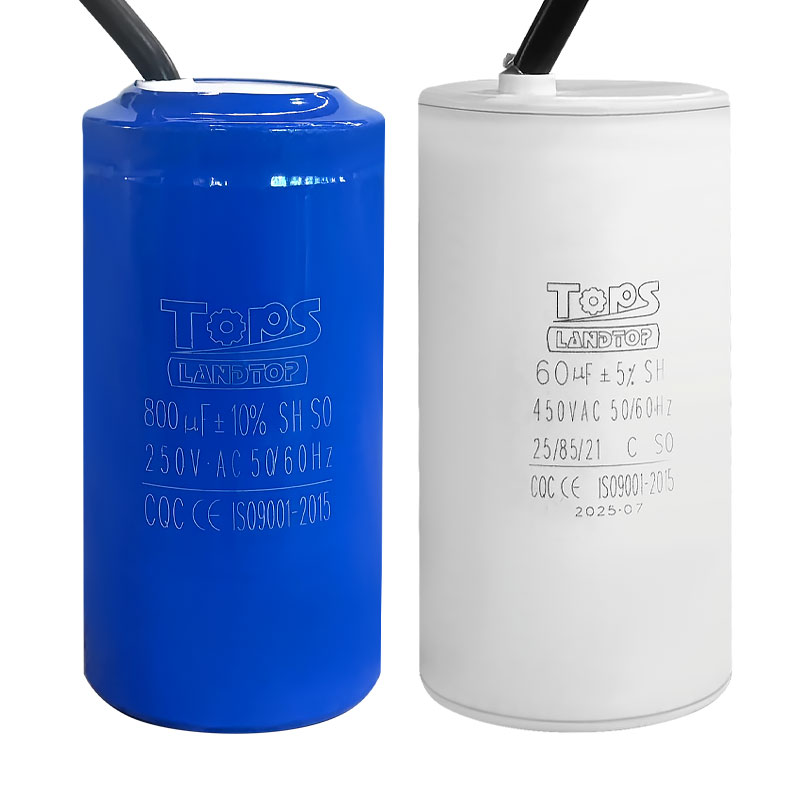
(Starting capacitor CD60 & Running capacitor CBB60)
Self-excited synchronous brushless AC generators represent a paradigm shift in decentralized power generation, where capacitors serve as the linchpin for autonomous operation. Unlike traditional brushed systems requiring external DC excitation, these generators leverage strategically integrated capacitors to initiate and sustain magnetic fields through reactive power management. This innovation eliminates brush maintenance, reduces failure points, and enhances durability in harsh environments.
Capacitor-Driven Excitation Mechanism
The core function begins during generator startup. Residual magnetism in the rotor induces a minimal voltage in stator windings, creating a small current flow through connected capacitors. These capacitors—acting as reactive power reservoirs—amplify the current phase shift, progressively building the rotor's magnetic field until critical excitation thresholds are achieved. This autonomous field buildup exemplifies a closed-loop energy conversion system where electrical inertia is transformed into stable electromagnetic force. Crucially, capacitor values must align with generator impedance; under-sizing causes excitation failure, while over-sizing triggers voltage overshoot. Advanced designs employ adaptive capacitor banks that dynamically adjust capacitance to maintain excitation stability across variable loads.
Voltage Regulation via Reactive Power Compensation
Post-excitation, capacitors transition to voltage stabilizers. Synchronous generators inherently exhibit load-dependent voltage droop due to armature reaction. Capacitors counteract this by injecting leading reactive power (Q) into the system, neutralizing lagging reactive power drawn by inductive loads. This Q-compensation maintains terminal voltage within ±2% of rated values without electronic regulators. The capacitor's reactance (XC = 1/2πfC) directly governs compensation intensity—higher capacitance lowers XC, enabling greater reactive current flow. Modern systems integrate capacitors with thyristor-controlled reactors to achieve granular voltage tuning, particularly crucial for nonlinear loads.
Harmonic Mitigation and System Efficiency
Beyond excitation and voltage control, capacitors suppress harmonic distortions. Stator winding harmonics—induced by magnetic saturation or load imbalances—generate parasitic currents that reduce efficiency and cause overheating. Capacitors form tuned LC filters that shunt specific harmonic frequencies (e.g., 5th, 7th) to ground, lowering total harmonic distortion (THD) below 5%. This preserves waveform integrity and reduces core losses by up to 15%, directly enhancing generator efficiency. Additionally, by minimizing reactive power circulation in distribution networks, capacitors reduce I2R transmission losses, contributing to system-wide energy conservation.
Future-Forward Applications
The capacitor-centric excitation model enables renewable energy integration. In wind/solar-hybrid systems, these generators provide grid-forming inertia, with capacitors ensuring seamless excitation during intermittent renewable output. Research now focuses on solid-state capacitors with AI-driven capacitance control, promising real-time adaptation to grid disturbances. Such advancements position self-excited brushless generators as cornerstones of resilient microgrids and sustainable infrastructure.
(Note: This content is generated by AI technology. The accuracy and reliability of the information should be independently verified. FUZHOU LANDTOP CO., LTD. assumes no liability for consequences arising from the use of this AI-generated material.)
Electromechanical Energy Conversion Efficiency Limits
Rectifier Function in Brushless Synchronous Generators
Related Article