Electromechanical Energy Conversion Efficiency Limits
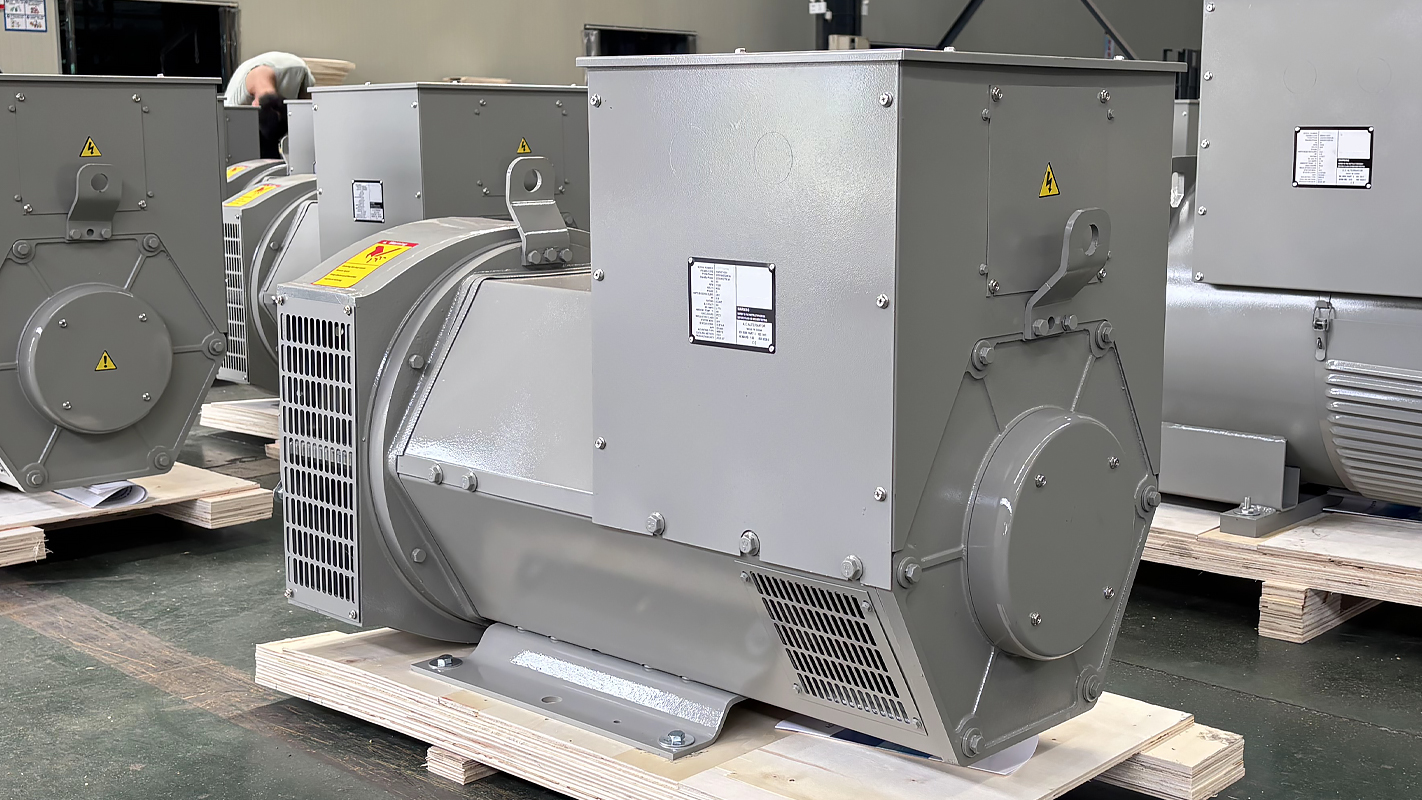
(LANDTOP brand single-bearing brushless synchronous A.C. alternator)
The pursuit of peak energy conversion efficiency in electromechanical systems confronts fundamental physical barriers rooted in thermodynamics and quantum mechanics. At the core lies the Carnot limit dictating maximum theoretical efficiency for heat-based systems, while quantum tunneling effects impose constraints on electron flow in solid-state devices. These immutable boundaries define the ultimate performance thresholds for generators, motors, and transformers.
Material science offers the primary pathway to transcend conventional limitations. Novel wide-bandgap semiconductors like gallium nitride and silicon carbide reduce conductive losses by enabling higher-temperature operation and lower switching resistance. Simultaneously, amorphous metal alloys in transformer cores diminish hysteresis losses through optimized magnetic domain alignment. These advanced materials collectively push system efficiencies toward 99% territory by minimizing parasitic energy dissipation at microscopic levels.
Quantum-scale engineering emerges as the next frontier. Electron wavefunction manipulation via heterostructure design allows controlled charge carrier movement, effectively bypassing traditional resistive losses. Topological insulator applications demonstrate potential for near-lossless electron transport along material boundaries. When integrated with superconducting components operating at critical temperature points, these approaches reconfigure energy pathways at subatomic levels.
Artificial intelligence transforms system optimization paradigms. Deep reinforcement learning algorithms dynamically model electromagnetic field interactions, fluid dynamics, and thermal gradients to generate geometries previously unachievable through human design. Generative adversarial networks iteratively refine winding configurations and magnetic circuit topologies, converging toward theoretically optimal structures. This autonomous design evolution continuously narrows the gap between theoretical maxima and practical implementations.
Future breakthroughs will emerge from cross-domain convergence. Nano-thermoelectric systems may harvest waste heat through phonon engineering, while magnetocaloric materials could replace compression cycles in cooling applications. Electrodynamic wireless power transfer principles show promise for eliminating conductive losses entirely in rotating systems. The integration continuum spans quantum materials, photonic energy transfer, and biocomposite insulation – each contributing fractional efficiency gains that collectively redefine achievable limits.
(Note: This content is generated by AI technology. The accuracy and reliability of the information should be independently verified. FUZHOU LANDTOP CO., LTD. assumes no liability for consequences arising from the use of this AI-generated material.)
Generators Green Shift Under Dual Carbon Goals
Capacitors Power Brushless Self Excited Synchronous Generators
Related Article